An MVP isn't a smaller, buggier version of your full product — it's the smallest thing you can put in front of real users that tests your riskiest assumption. Eric Ries, who popularized the term in The Lean Startup, defined it plainly: an MVP is the version of a new product that allows a team to collect the maximum amount of validated learning about customers with the least effort. Get that definition wrong and you'll either ship something so thin it can't validate anything, or something so bloated it takes six months and a real budget to find out nobody wants it. This guide walks through how to scope, validate, build, and launch an MVP that actually answers the question you're asking — plus realistic cost and timeline numbers, the mistakes that sink most MVPs, and a simple prioritization template you can use today.
What "MVP" Actually Means (and Why Most Teams Get It Wrong)
The term gets used loosely, but Ries's original point was narrower and more useful than "build a stripped-down version." An MVP's job is to move you through the Build-Measure-Learn loop: build the smallest thing that tests a hypothesis, measure how real users actually behave, and use that data to decide whether to persevere, pivot, or stop. Speed through that loop is the entire point — it's a feedback engine, not a shipping milestone. A team that spends four months building a "minimal" product has usually failed at the exercise, regardless of how short the feature list looks on paper, because the loop only pays off if you close it fast enough to still change course based on what you learn.
MVP vs. Prototype vs. Minimum Marketable Product (MMP)
These three terms get used interchangeably, and it causes real confusion about what to actually build. A prototype demonstrates an idea — often with fake or hardcoded data — to align a team or persuade investors; it isn't meant for real users and it generates opinions, not usage data. An MVP is a real, working product, narrower in scope than your full vision, but functional enough that real users get real value and generate real behavioral data. A minimum marketable product (MMP) goes a step further: it has the polish, edge-case handling, and completeness to actually sell to customers, not just test a hypothesis with them. Most early-stage teams should move through these in order — prototype, then MVP, then MMP. Skipping straight from prototype to MMP means spending real budget before validating anything, and calling something an MMP without ever running it through MVP-stage validation just means you built the wrong product with better polish and a bigger invoice.
Step 1: Identify Your Riskiest Assumption
Before writing a single feature list, write down the one assumption that, if wrong, kills the business. Sometimes it's demand ("will anyone pay for this?"), sometimes it's technical feasibility ("can we actually process this data in real time?"), and sometimes it's behavioral ("will users switch from their current tool?"). CB Insights' analysis of 431 VC-backed companies that shut down since 2023 found poor product-market fit cited in 43% of post-mortems — more often than bad timing (29%) or unsustainable unit economics (19%). "Ran out of capital" shows up even more frequently, but it's almost always the final symptom, not the root cause. Your MVP's entire job is to test the assumption most likely to produce that outcome, as cheaply and quickly as possible. Everything else is scope you can cut.
Step 2: Validate Before You Write a Line of Code
The cheapest MVP is the one you never have to build. Before committing engineering time, test demand and behavior with lower-cost methods, and reserve custom software for the risk that's still unanswered afterward. A useful rule is to climb from cheap to expensive: validate demand first, then delivery, then automate.
- Landing page / smoke test — describe the product and offer a real signup or waitlist call-to-action. DoorDash's earliest version was a single landing page for a local delivery service, built before any product existed, simply to see if anyone would place an order.
- Concierge MVP — deliver the service manually, behind the scenes, to a handful of real customers to confirm the outcome itself creates value before automating any of it.
- Wizard of Oz MVP — let users interact with what looks like a working product while a human manually operates the backend, so you validate whether the interface and workflow drive the behavior you expect.
- Fake door test — ship a button, page, or feature that appears live but simply captures intent, to gauge demand for a specific feature before building it.
None of these replace building the real product eventually, but they're dramatically cheaper ways to fail fast if your core assumption is wrong — and they generate real evidence to bring into the scoping conversation instead of opinions and guesses. Even a week spent on one of these before kickoff routinely reshapes what actually goes into the build.
Step 3: Prioritize With a Simple Framework
List every feature you're tempted to include, then score each one on two axes: does it test the riskiest assumption, and can users understand the value without it? Anything that scores low on the first and high on the second gets cut. A simple MVP template looks like this:
- Core loop — the single action a user repeats that delivers value (e.g., "upload a document, get a summary").
- Must-have — the minimum supporting features needed for the core loop to function (auth, basic data storage, one integration).
- Nice-to-have — deferred to post-MVP: polish, edge-case handling, secondary features, admin tooling.
- Explicitly out of scope — write this down too; it prevents scope creep mid-build.
Step 4: Choose Your Tech Stack for Speed, Not Scale
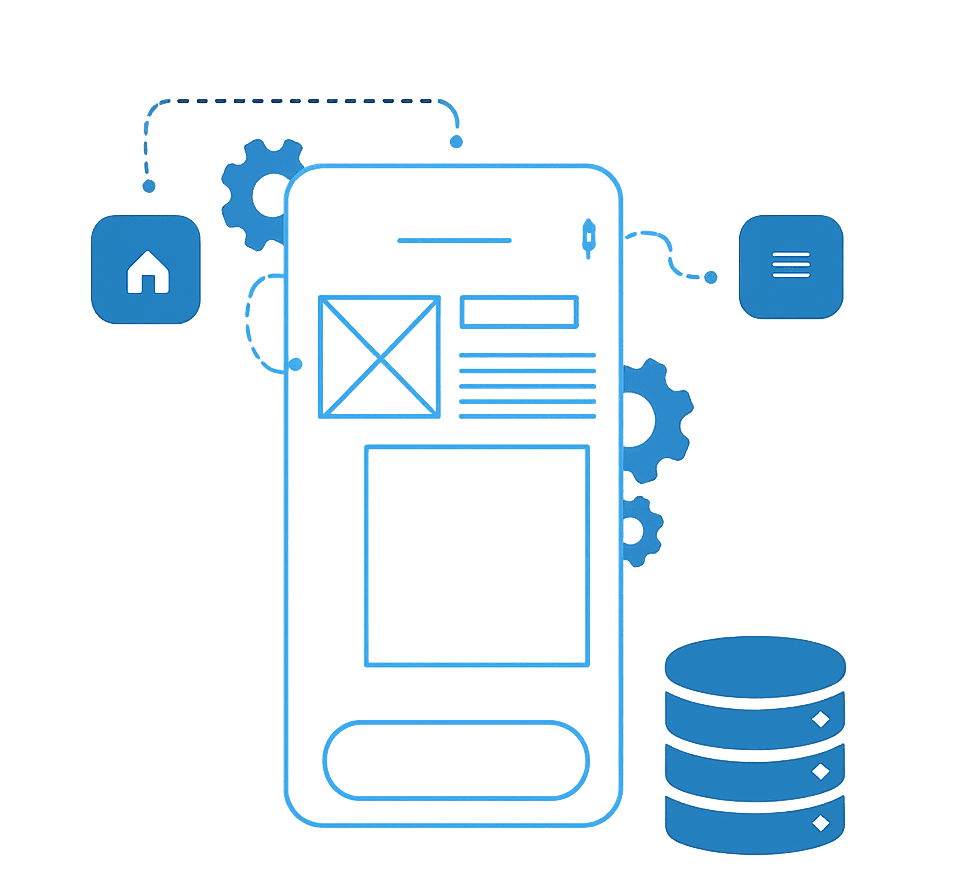
An MVP's tech stack should optimize for how fast you can validate and iterate, not for how it'll perform at 10 million users — that's a problem you'll be lucky to have later. A common, fast-to-ship stack pairs a React or React Native frontend with a managed backend (Supabase, Firebase, or a lightweight Node/Postgres API) and off-the-shelf auth, payments, and email, so engineering time goes into the parts that are actually unique to your product. AI-assisted coding tools have compressed a lot of this further in 2025-2026 — scaffolding, boilerplate CRUD, and basic UI can be generated in hours instead of days — but the underlying discipline hasn't changed: don't build infrastructure for a scale problem you don't have yet, and don't reach for a bespoke solution when a managed service does the job for a fraction of the engineering time.
Realistic MVP Cost and Timeline Benchmarks
Founders are routinely quoted numbers that have little to do with their actual scope. Across 2025-2026 industry estimates, the ranges generally break down like this:
- Narrow, single-platform MVP with a small senior team: about 6 weeks, in the tens of thousands of dollars.
- Typical startup MVP (web app, basic backend, a handful of integrations): roughly 10-14 weeks and $10,000-$50,000.
- Multi-platform or AI/ML-enabled MVP with custom model or data-pipeline work: 16-20+ weeks, often $100,000 and up.
If a quote or internal estimate lands meaningfully outside these ranges, treat it as a scope signal rather than a market-rate signal — either the "MVP" has quietly turned into a full product, or it hasn't been scoped tightly enough yet. It's also worth budgeting an additional 15-25% beyond the initial build for hosting, third-party tools, and the first round of post-launch iteration. This is the line item most estimates leave out, and it's a common reason MVPs run out of runway right after launch rather than during the build.
Step 5: Define What "Validated" Looks Like Before You Launch
Decide your success metric before launch, not after. "People seemed to like it" isn't a metric. "20% of signups complete the core loop within their first session" is. Without a pre-defined bar, it's tempting to retroactively interpret any result as validation — which defeats the purpose of testing an assumption at all.
“If your MVP timeline keeps slipping, the problem usually isn't the engineering team — it's that the scope was never actually minimal.”
Common MVP Mistakes That Sink Otherwise Good Ideas
Most MVPs don't fail because the underlying idea was bad — they fail because the process around building them broke down in one of a few predictable ways. Each of these is avoidable, and each one shows up over and over across post-mortems, founder retrospectives, and the engagements we run at Manbal.Ai:
- Confusing "MVP" with "smaller version of the full product." Adding every feature "just in case" inflates cost and timeline and delays the only thing that matters: real user feedback. Feature creep is consistently cited as the single most common reason MVP timelines and budgets run over.
- Skipping user research because writing code feels like progress. Talking to ten prospective users before building anything is unglamorous compared to shipping features, but it's the fastest way to avoid building the wrong thing perfectly.
- Optimizing for scale you don't have yet. Architecture decisions made for a hypothetical million users slow down a team that doesn't have a hundred yet, and rarely survive contact with real usage patterns anyway.
- Not defining a success metric before launch. Without a pre-committed bar, any result gets retroactively reinterpreted as validation, which defeats the purpose of testing anything in the first place.
- Treating the MVP as the finish line instead of one loop. Teams that build once, launch, and stop iterating rarely reach product-market fit — the Build-Measure-Learn loop is meant to repeat, not run once.
The pattern behind most of this: CB Insights' post-mortem data on VC-backed shutdowns shows running out of capital as the most frequently cited proximate cause, but the underlying driver in most of those cases was poor product-market fit discovered too late — after the runway for a real pivot was already gone. An MVP done right is what buys you the time to discover that early, while you can still afford to act on it.
Ready to turn your idea into a working MVP?
Manbal.Ai's MVP acceleration team helps founders scope ruthlessly and ship in weeks, not quarters.
Book a Free CallHow Manbal.Ai Approaches MVP Builds
We start every MVP engagement with a one-week scoping sprint — before any code is written — to pressure-test your core assumption and cut scope down to what's truly minimal. From there, our MVP acceleration service handles the build end to end, our full-stack engineering team covers everything from the backend API to deployment, and when the product needs a UI that actually converts, our experience design team gets involved early rather than as a late coat of paint. If you're earlier than a build — still validating the idea or the market — our consulting engagements can help you get there first.